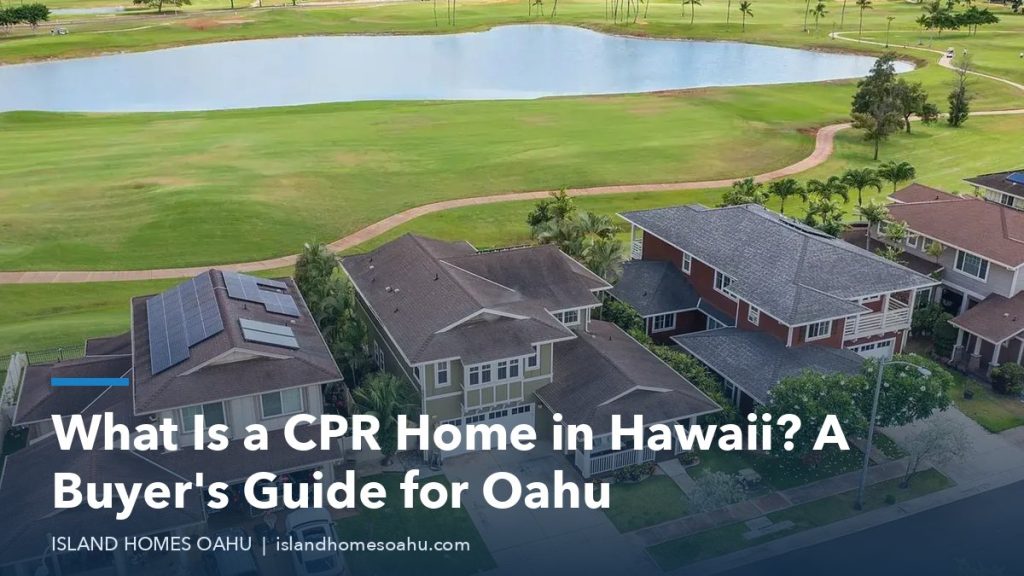
A CPR home in Hawaii is a home owned under a Condominium Property Regime: you own your unit, and you share ownership of the land and other common elements with the other owners in the project. On Oahu, the classic example is two houses on one lot, where each house is its own condo unit even though neither one looks anything like a condo building.
Here is how a CPR works, what to read, how costs and insurance are shared, what it means for your loan, and what I check before an offer.
Quick answer
A CPR (Condominium Property Regime) is a form of ownership under Chapter 514B of the Hawaii Revised Statutes, not a type of building. You own your unit plus a percentage of the common elements, which usually includes the land. Yards and parking are often limited common elements: yours to use, not yours alone to own. The declaration, bylaws, condo map and house rules decide who can build, who pays and who insures. A CPR is not a subdivided lot.
In this guide:
- What is a CPR home in Hawaii?
- What you own: unit, common elements and limited common elements
- CPR vs a subdivided lot
- CPR documents: declaration, bylaws, map and house rules
- Shared costs and who pays for what
- Insurance on a CPR
- Financing a CPR home
- Buying a new CPR from a developer
- What to check before you buy
- Mistakes to avoid
- FAQ
- Bottom line
What Is a CPR Home in Hawaii?
The Hawaii Real Estate Branch puts it simply in its brochure So You Want To Go Condo?: a condominium is a form of ownership, not a structure or a building. CPR is that form of ownership plus the governing process that comes with it, under HRS Chapter 514B.
Under HRS 514B-3, a condominium is real estate where portions are designated for separate ownership and the rest is designated for common ownership solely by the owners of those portions. The same section says real estate is not a condominium unless the undivided interests in the common elements are vested in the unit owners. So the land under a CPR home in Hawaii is usually owned together by the unit owners.
The brochure notes condos can be townhouses, high rise units, boat slips, even detached houses, and a Hawaii project must contain two or more units. On Oahu, “a CPR” usually means a detached house that shares a lot with another home.
A CPR is created when the owners record the declaration, the bylaws of the association, the condominium map and the master deed or lease at the Bureau of Conveyances or the Land Court (HRS 514B-31).
What You Own: Unit, Common Elements and Limited Common Elements
- Your unit. The part designated for separate ownership, with an exit to a public road or to a common element leading to one (HRS 514B-3). The declaration (or the default rules in HRS 514B-35) says where it ends.
- Common elements. Everything in the project that is not a unit. Your share is your “common interest,” a percentage set in the declaration.
- Limited common elements. Common elements reserved for the exclusive use of fewer than all the units. The state brochure says these often include yard areas and parking spaces, and that they give exclusive use, not ownership. HRS 514B-35 also treats lanais, patios and exterior doors serving one unit as that unit’s limited common elements unless the declaration says otherwise.
So “this is your yard” usually means “this land is a limited common element assigned to your unit.” The difference shows up when you build, sell or refinance.
CPR vs a Subdivided Lot
A CPR is not a subdivision. The state brochure says CPRing a property does not decide what or how much can be built, and does not change county zoning, density or use rules. HRS 514B-5 requires every CPR to conform to the county zoning and permitting rules for the property.
The Real Estate Branch Condo Developer FAQs put it this way: subdivision creates separate parcels free and clear of other property, while condo owners hold an interest in the whole undivided property. The same page warns that building rights belong to the entire undivided property, which may mean some units cannot build homes. So never assume you can add on.
| Question | CPR unit | Subdivided lot |
|---|---|---|
| Who owns the land? | All unit owners together, by common interest | You own your parcel |
| Your yard | Usually a limited common element you have exclusive use of | Part of your parcel |
| Building rights | Belong to the whole undivided property; the documents and county rules decide | Set by county rules for your parcel |
| Governing documents | Declaration, bylaws, condo map, house rules if any | Deed, plus any recorded covenants |
| Neighbors’ say | Other owners vote on amendments and shared items | Only what recorded covenants give them |
Still deciding? My post on condo vs house on Oahu covers the bigger trade offs.
CPR Documents: Declaration, Bylaws, Condo Map and House Rules
The Hawaii Real Estate Commission’s Realities of Condo Ownership handout says it is imperative to read your condo documents, and that buying makes you a member of the association bound by them. Here is what each one does on a CPR home in Hawaii.
The declaration
The declaration creates the condominium. Under HRS 514B-32 it describes the land, the units, each unit’s common interest and permitted uses, the common elements, and which limited common elements belong to which unit. Unless the law or the declaration says otherwise, an amendment takes the vote or written consent of owners holding at least 67 percent of the common interest. On a two unit CPR split 50/50 that uses this default, no change happens unless both owners agree.
The bylaws
The bylaws set how the association is run: the board, officers, elections and how binding decisions get made (HRS 514B-108). On a two house CPR the board may be you and your neighbor.
The condominium map
The map shows the units and often the limited common element areas. I walk the property with it so buyers see where their area ends, which is not always where the fence is.
House rules
Per the Commission, house rules must be based on the bylaws or declaration and can include fines; associations may levy reasonable fines for violations (HRS 514B-104). Many small CPRs have none.
The brochure lists a “master deed or lease” among the creating documents, so some CPRs sit on leased land. If the listing says leasehold, read my guide to leasehold vs fee simple on Oahu before anything else.
Shared Costs and Who Pays for What
Under HRS 514B-41, common expenses are charged to owners in proportion to their common interest, unless the declaration or bylaws say otherwise. Limited common element costs, like repair and replacement, generally go to the owner of the unit they belong to.
In a high rise that becomes a monthly maintenance fee. In a two house CPR there may be no monthly fee, and owners split shared bills as they come up. The Commission’s handout notes thin reserves can lead to special assessments. In my experience small CPRs run far more informally than big buildings, so ask what is shared (driveway, water line, sewer, fences), how bills get split, and whether money is set aside. My post on Oahu HOA fees explains how budgets and reserves work in larger projects.
Also verify: unpaid assessments become a lien on the unit with priority over other liens except property taxes and mortgages recorded before the association records its lien (HRS 514B-146). Ask for a statement of any unpaid assessments before closing.
Insurance on a CPR Home in Hawaii
Under HRS 514B-143, unless the declaration or bylaws provide otherwise, the association must insure the common elements at full replacement cost and carry liability coverage, plus flood insurance if the property is in a FEMA special flood hazard area.
With detached units, the board may let each owner insure their own unit, as long as coverage meets the law, the association is named as an additional insured, and proof goes to the association every year. In my experience that is common on two house CPRs, but the documents control. Before you remove contingencies, confirm who insures what and get your own quote.
Financing a CPR Home
To a lender, a CPR unit is a condo unit even when it is a detached house, so your lender may review the project, not just the house. For example, the Fannie Mae Selling Guide section on the waiver of project review waives project review for two to four unit condo projects, while insurance and some other requirements still apply.
Each loan program has its own condo rules, so tell your lender on day one it is a CPR. If you are using VA, ask your lender early whether the project needs VA approval; my post on VA approved condos on Oahu covers what to do when a project is not on the list. Closing costs work like any purchase; see closing costs for buyers on Oahu.
Thinking about a CPR listing right now? Get your Buyer Game Plan, or call or text me at (808) 459-6450. I am Devin Hammack with Team Taparra at eXp Realty.
Buying a New CPR From a Developer
Buying from the person who created the CPR adds protection. Per the state brochure, a project must be registered with the Commission before units are offered, and the developer’s public report is a disclosure statement for buyers. Its effective date is not an approval of the project.
Under HRS 514B-86, a contract with a developer is not binding until you receive the public report (with the declaration, bylaws, house rules if any and a condo map) plus notice of your 30 day cancellation right, and that right is waived or runs out. You can cancel until midnight of the 30th day after you sign and receive those items, unless you waive it or close first. Buying from a later owner, those developer rules generally do not apply, so your own review matters more.
What to Check Before You Buy a CPR on Oahu
What I work through with buyers (it does not replace your attorney):
- Get the full recorded documents. Declaration, bylaws, condo map, any amendments and any house rules. Under HRS 514B-154.5 associations must make them available to owners, so the seller can get them.
- Find your unit and limited common element on the map, then walk it.
- Read the permitted uses for each unit.
- Ask the county what can be built. The Real Estate Branch suggests giving the county the tax map key and asking how many dwellings are allowed and under what conditions.
- Check for ADU or ohana covenants. Per the Real Estate Branch FAQ, Honolulu does not allow ADUs to be sold separately; owners record a covenant not to CPR the lot to split an ADU from the main home, and ohana permits carry a similar covenant.
- Confirm permits for both homes. The declaration must state the project complies with zoning and building codes (HRS 514B-32).
- Map the shared systems and ask whether cost sharing is in writing.
- Sort out insurance before contingencies end.
- Ask about unpaid assessments and any disputes between owners.
- Loop in your lender and an attorney early.
If this is your first purchase, my first-time home buyer guide for Oahu covers the whole process.
Mistakes to Avoid With a CPR
- Treating the yard like a lot you own. It is usually a limited common element.
- Assuming you can expand. The documents and the county decide, and the other owner may have to sign off.
- Skipping the documents because “it’s just two houses.” Small CPRs often have the fewest written answers.
FAQ About CPR Homes in Hawaii
What does CPR mean in Hawaii real estate?
Condominium Property Regime, a form of ownership under HRS Chapter 514B. You own your unit and share an undivided interest in the common elements, usually including the land, with the other owners.
Is a CPR the same as owning my own lot?
No. Subdivision creates separate parcels; a condominium gives owners an interest in the whole undivided property, with exclusive use areas called limited common elements.
Do I pay HOA fees on a CPR home?
Common expenses are shared by common interest unless the documents say otherwise. Some small CPRs have no monthly fee and split bills as they come up.
Who insures a CPR house?
By default the association insures the common elements. For detached units, the board may let owners insure their own units if coverage meets the law and the association is named as an additional insured.
Can I add on to my CPR home?
Only if the documents and county rules allow it. Building rights belong to the whole property, and amending the declaration generally takes 67 percent of the common interest.
Can I get a regular mortgage on a CPR home?
Often yes, but lenders treat it as a condo unit and may review the project. Tell your lender it is a CPR at the start.
The Bottom Line on a CPR Home in Hawaii
A CPR home in Hawaii can be a solid way to own a house on Oahu, but you are buying into shared ownership, not a lot of your own. Read the documents, know your limited common element, settle insurance and shared costs, ask the county what can be built, and bring in your lender early. This is general information from my experience, not legal advice; have your attorney review your documents.
Sources
- Hawaii Revised Statutes 514B-3: Definitions
- HRS 514B-5: Conformance with county land use laws
- HRS 514B-31: Creation
- HRS 514B-32: Contents of declaration
- HRS 514B-35: Unit boundaries
- HRS 514B-41: Common profits and expenses
- HRS 514B-86: Requirements for binding sales contracts; purchaser’s right to cancel
- HRS 514B-104: Association powers
- HRS 514B-108: Bylaws
- HRS 514B-143: Insurance
- HRS 514B-146: Lien for assessments
- HRS 514B-154.5: Association documents to be provided
- Hawaii Real Estate Branch: So You Want To Go Condo? (revised June 2021)
- Hawaii Real Estate Commission: Realities of Condo Ownership
- Hawaii Real Estate Branch: Condo Developer FAQs
- Fannie Mae Selling Guide B4-2.1-02: Waiver of Project Review
Looking at a CPR, or any home on Oahu? Get your Buyer Game Plan, or call or text me at (808) 459-6450. I am Devin Hammack with Team Taparra at eXp Realty.
Get the free 11 step first time buyer plan by email: what you can really afford, condo vs house, and help with closing costs.
Send Me the Planor call or text (808) 459-6450