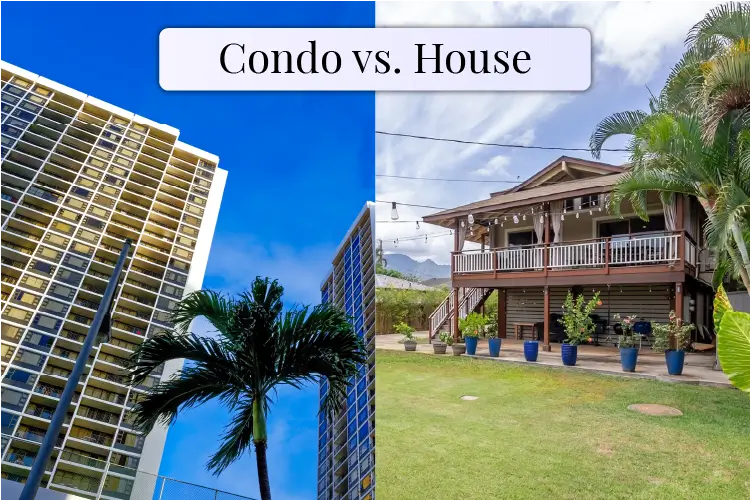
Condo vs house on Oahu comes down to budget first and lifestyle second, because the price gap here is huge. In August 2026 the median Oahu single-family home sold for $1,240,000 and the median condo for $510,000, so the real question is what each costs you every month. Here is the honest version, with current numbers and sources.
Quick answer
A condo costs far less to buy (August 2026 median $510,000 vs $1,240,000 for a house), but its monthly maintenance fee counts when a lender qualifies you, and a board sets the rules. A house costs more and every repair is yours, but you control the property and the land. Compare the full monthly cost, not the list price.
In this guide
- The August 2026 numbers
- Monthly cost
- Insurance
- Property tax
- Ownership and CPR homes
- Leasehold condos
- VA loans and condos
- Resale
- Which fits you
- FAQ
Condo vs House on Oahu: The August 2026 Numbers
These are the Honolulu Board of Realtors resale figures for August 2026, the most recent month reported as I write this.
| Single-family home | Condo | |
|---|---|---|
| Median sale price | $1,240,000 | $510,000 |
| Change from August 2025 | up 12.2% | down 1.0% |
| Homes sold in the month | 264 | 365 |
| Median days on market | 17 (22 a year earlier) | 37 (48 a year earlier) |
| Median share of original asking price received | 100% | 97.1% |
| Active listings at month end | 794 | 2,512 |
The typical Oahu house sold for $730,000 more than the typical condo. Median means half sold for more and half for less: the same report shows 27% of August house sales closed under $1 million, and 48% of condo sales closed under $500,000.
Notice the speed and the choice too. Houses sold in a median of 17 days at 100% of asking. Condos took 37 days at 97.1%, with more than three times as many listings. Condo buyers have more options and room to negotiate; house buyers compete for fewer homes. The bigger picture is in my Oahu real estate market update for 2026.
Monthly Cost: The Price Is Only Half the Story
Buyers compare list prices. Lenders care about the monthly number, and that is where condos and houses trade places.
Maintenance fees count when you qualify. Almost every condo has a monthly fee, and some single-family neighborhoods have association dues too. Fannie Mae’s underwriting rules count association dues, special assessments and ground rent in your monthly housing expense, so the fee is part of the payment a lender uses to size your loan. Have your lender run your numbers with the real fee. Fees vary a lot by building; my breakdown of Oahu HOA fees explains why.
What the fee pays for. Condos claw some of it back here. Depending on the building, the fee can cover the master insurance policy, common-area utilities, grounds and shared systems, and reserves, which the Hawaii Real Estate Branch describes as money collected regularly to pay large future expenses as the building ages. The budget shows exactly what is included. A house owner pays for all of that directly: roof, termites, water heater, yard and every repair.
Reserves and special assessments. When reserves fall short of a repair, the association can charge owners a special assessment. The Board of Realtors’ president noted in the August report that condo buyers are weighing fees, insurance and reserve funding as part of the monthly cost. Ask for the reserve study, budget and recent board minutes. My first condo in Honolulu checklist covers what to request.
Weighing a condo against a house? Get your Buyer Game Plan, or call or text me at (808) 459-6450. I am Devin Hammack with Team Taparra at eXp Realty.
Condo Insurance vs Homeowners Insurance on Oahu
Insurance works very differently for the two.
In a condo, Hawaii law requires the association to carry property and liability insurance unless the declaration or bylaws say otherwise. The master policy covers the building structure, common areas and the original “as built” construction of the units. Where the association carries hurricane or flood coverage, that is part of the building’s program too, paid through the maintenance fee. You do not buy a separate hurricane or flood policy for the building.
What you buy is an HO-6, the owner’s policy for the walls-in: belongings, upgrades, liability, living expenses after a loss and, depending on the policy, the association deductible if it is charged to your unit. It is not required by law, but lenders and associations may require it.
The catch is the cost of that master policy. The Legislature found master policy premiums had increased exponentially and deductibles had risen from $10,000 to $25,000 per unit to as much as $250,000. Act 296 (2025) reactivated the Hawaii Hurricane Relief Fund for eligible condos and created a loan fund to help buildings stay insurable. Those costs flow into the fee or special assessments, so ask for the building’s deductible and premium history early.
In a house, you insure the whole structure yourself. The state Insurance Division lists what drives the premium: rebuild cost (not market value), location risks, claims history and your deductible. Get a quote during your inspection period.
Property Tax on a Condo vs a House
Honolulu taxes condos and houses at the same rates. The assessed value and the home exemption drive the bill.
- For the July 1, 2026 to June 30, 2027 tax year, the Residential class rate is $3.50 per $1,000 of net taxable value.
- The home exemption for your primary home is $120,000 off the assessed value ($160,000 at 65 and older), rising to $140,000 and $180,000 effective July 1, 2027.
- A house or condo assessed at $1,000,000 or more with no home exemption generally falls into Residential A, taxed at $4.00 per $1,000 on the first $1,000,000 and $11.40 per $1,000 above that.
For illustration only: a home assessed at $510,000 with the exemption is taxed on $390,000, or $1,365 a year at $3.50. One assessed at $1,240,000 is taxed on $1,120,000, or $3,920 a year. The city’s assessment is not your purchase price, so look up the real one, and file for the exemption when you move in.
Ownership and Rules: What You Actually Control
In a fee simple house you own the structure and the land, and you make the decisions within county rules. You also carry every repair.
In a condo you own your unit plus a percentage interest in the common elements, and the land is a common element shared with the other owners. Yards and parking stalls are often “limited common elements”: exclusive use, not ownership. The bylaws and house rules cover pets, rentals, renovations and sometimes flooring. Read them before you write an offer.
The Oahu twist: CPR homes. Some homes here that look like regular houses are legally condos. CPR stands for Condominium Property Regime, and the state Real Estate Branch is clear that a condominium is a form of ownership, not a type of building. For example, two detached homes on one lot can each be sold separately. You get a house, but the loan, insurance and paperwork follow condo rules, and there may be a small shared fee. CPRing is not subdividing, so it does not change what the county allows on the lot. Read the declaration and bylaws so you know what you are buying.
Leasehold: The Trap That Catches Condo Buyers
Some Oahu condos are leasehold. As the Honolulu Board of Realtors explains, a leasehold buyer does not own the land, pays ground rent, and can use the land only for the years left on the lease. That rent is on top of your maintenance fee and counts when a lender qualifies you, which is why leasehold units look like bargains online. Read my leasehold vs fee simple guide before you chase one and ask your lender how the remaining term affects your loan.
Buying With a VA Loan? Condos Have an Extra Step
The VA loan works on Oahu for condos and houses alike, with one condo rule: VA’s buyer’s guide says the condo must be in a VA-approved project, and a project not on VA’s list must be submitted to VA for review. That review takes time, so we check a building’s status before we tour. Houses have no such step. My guide to VA approved condos on Oahu covers what to do when a building is not on the list, and my VA loan guide for Oahu covers the rest.
Resale and What the Market Is Showing
Land is the scarce thing on an island, and a fee simple house comes with it. In August the house median rose 12.2% from a year earlier while the condo median slipped 1.0%, and condo inventory was up 4.1% while house inventory barely moved. One month is not a forecast. What is clear is that condo values are tied to things outside your unit: the fee, reserves, assessments and master insurance. That does not make a condo a bad buy. Buy one in a building whose finances you have read, and one you would be happy owning for a long time.
When a Condo Makes More Sense, and When a House Does
A condo usually fits better if:
- Your pre-approval, with the fee counted, lands well below where the house market sits.
- You travel, deploy or work long hours and do not want a yard, a roof or termite tenting on your plate.
- You would rather have a shorter commute than more square footage.
- You want to start building equity now instead of renting while you save for a house.
A house usually fits better if:
- You want more interior space, a yard, or room for pets and hobbies.
- You plan to stay a long time and want to own the land.
- You want control over renovations and rentals without asking a board.
- You are using a VA loan and want to skip the condo approval question entirely.
Everyday costs matter too. My cost of living on Oahu guide walks through where the money actually goes.
How I Help You Decide
I am a buyer’s agent, not a salesman for one property type. We start with the monthly number your lender gives you, then tour a condo and a house in that range so you feel the difference in person. For condos, I pull the budget, reserve study, insurance summary and house rules early. Search Oahu homes and condos to get a sense of what is out there, or reach out and we will talk it through. No pressure, ever.
Frequently Asked Questions
Are condos cheaper than houses on Oahu?
Yes, by a lot. In August 2026 the median Oahu condo sold for $510,000 and the median single-family home for $1,240,000, according to the Honolulu Board of Realtors. Lenders also count the condo’s monthly fee when you qualify.
Do condo maintenance fees affect how much I can borrow?
Yes. Fannie Mae counts owners’ association dues, special assessments and ground rent in your monthly housing expense, so the fee is part of the payment a lender uses to qualify you.
What insurance do I need for a condo on Oahu?
The association’s master policy covers the building, common areas and original unit construction, including hurricane or flood coverage where the association carries it. You carry an HO-6 policy for the walls-in: belongings, upgrades, liability and possibly the association deductible.
Can I use a VA loan to buy a condo in Hawaii?
Yes, if the condo is in a VA-approved project. A project not on VA’s list must be submitted to VA for review. Houses skip this step.
What is a CPR home on Oahu?
CPR means Condominium Property Regime, a form of ownership under Hawaii’s condo law. It lets two or more homes on one lot be owned separately. A detached house can still follow condo rules for financing, insurance and paperwork.
Is a leasehold condo a bad idea?
Not always, but understand it first. You do not own the land, you pay ground rent on top of the fee, and your use ends when the lease does.
Bottom Line
A condo costs far less, but you share control and pay a fee lenders count, so the building’s finances matter as much as the unit. A house costs much more and every repair is yours, but you own the land. Compare the full monthly cost with a lender and read the condo documents before you commit.
Ready to see both side by side? Get your Buyer Game Plan, or call or text me at (808) 459-6450. I am Devin Hammack with Team Taparra at eXp Realty.
Sources
- Honolulu Board of Realtors, Market Report: August 2026
- Honolulu Board of Realtors, Property Type (fee simple and leasehold)
- Fannie Mae Selling Guide B3-6-03, Monthly Housing Expense for the Subject Property
- Hawaii Real Estate Branch, Types of Condo Insurance Policies (May 2025)
- Hawaii Insurance Division, Homeowners Insurance FAQs
- Hawaii State Legislature, SB1044 CD1 (2025), enacted as Act 296
- Hawaii Real Estate Branch, Condominium Governance FAQs
- Hawaii Real Estate Branch, So You Want To Go Condo?
- City and County of Honolulu RPAD, Real Property Tax Rates, July 1, 2026 to June 30, 2027
- City and County of Honolulu RPAD, Home Exemption
- City and County of Honolulu RPAD, Residential A
- U.S. Department of Veterans Affairs, VA Home Loan Guaranty Buyer’s Guide
Get the free 11 step first time buyer plan by email: what you can really afford, condo vs house, and help with closing costs.
Send Me the Planor call or text (808) 459-6450