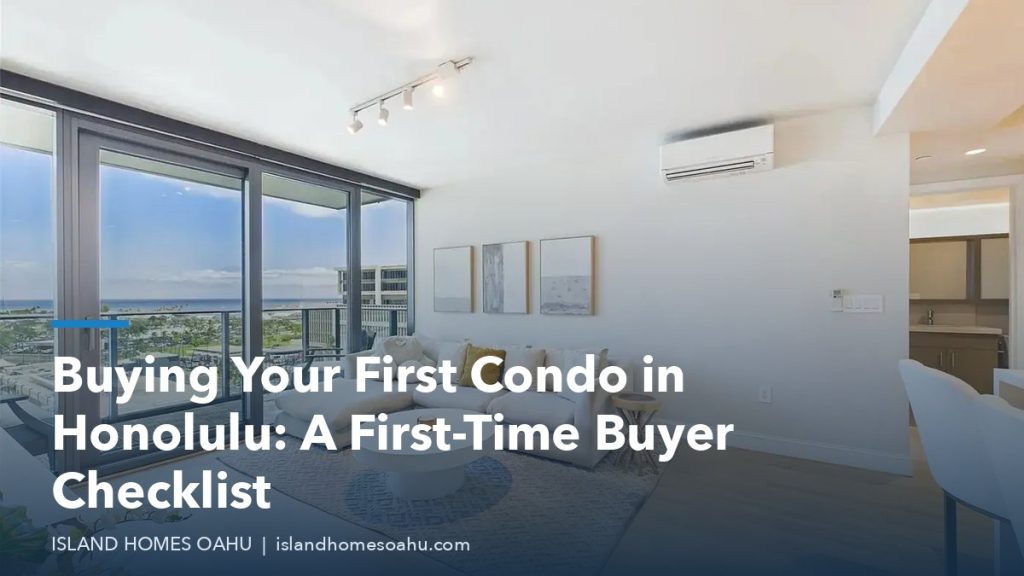
If you are buying your first condo in Honolulu, the most important thing to know is this: you are buying into a building and an association, not just a unit. The buyers who do well check the land ownership, the monthly fee, the loan approval, the reserves and the house rules before they fall in love with the view.
For a lot of first-time buyers in town, a condo is the realistic first step into ownership. Here is the checklist I walk my own buyers through before we write an offer, with links to the official pages so you can check the rules yourself. You can also browse current listings on my Honolulu homes for sale page.
Quick answer
Before you offer on your first condo in Honolulu, confirm five things: whether it is fee simple or leasehold, what the maintenance fee covers, whether your loan type works in that building (FHA, VA or conventional), how healthy the reserves are and whether any special assessment is coming, and what the house rules say about pets, rentals and renovations. Then get pre-approved with the fee included so you know your real monthly number.
In this guide:
- How condo ownership works in Hawaii
- Is it fee simple or leasehold?
- What the maintenance fee covers
- FHA, VA and conventional condo approval
- Reading the association documents
- Reserves, fire safety and special assessments
- House rules, parking and storage
- Condo insurance: master policy vs HO-6
- Your real monthly number and the home exemption
- New developer units vs resale
- FAQ
- Bottom line
How Condo Ownership Works in Hawaii
Hawaii’s Real Estate Branch puts it simply: a condominium is a form of ownership, not a type of building. You own your unit and share the common elements, like the lobby, roof and parking structure, with every other owner.
The building is run by an association of unit owners (you will often hear it called the AOUO or AOAO) and its board of directors. The rules come from Hawaii’s condo law, Chapter 514B of the Hawaii Revised Statutes, plus the building’s own declaration, bylaws and house rules. The Real Estate Branch condo resources page has free guides worth bookmarking.
1. Is It Fee Simple or Leasehold?
This is the first thing I check on any Honolulu condo. Fee simple means you own your unit and your share of the land. Leasehold means you own the unit but lease the land, and the lease has an end date. Leasehold units often look like a bargain for exactly that reason. Some can make sense, but you need to know what you are buying. My leasehold vs. fee simple guide breaks it down.
On a leasehold unit, I want to see the lease itself: when it ends, what the lease rent is and when it can change. The association has to make any master lease available to owners and their agents, so ask early, and ask your lender whether the remaining term affects financing.
2. What Does the Maintenance Fee Cover?
Every condo has a monthly maintenance fee paid to the association. Depending on the building, it can cover water, sewer, the master insurance policy, maintenance, staff, amenities and reserves. Two units at the same price can have very different fees, so compare what is included, not just the number.
The fee also counts in your loan qualification, right next to your mortgage payment. A higher fee means a lower price you qualify for. My Oahu HOA fees guide goes deeper on this.
A few questions I ask about every fee:
- What utilities are included, and is electricity separate?
- How much of the fee goes into the reserve fund?
- Has the fee gone up recently, and does the budget show more increases coming?
3. FHA, VA and Conventional Condo Approval: Can Your Loan Be Used in This Building?
Not every building is approved for every loan type, and this catches a lot of first-time buyers.
FHA loans
According to HUD’s FHA condominium page, FHA insures condo loans in an FHA-approved project, or in a project that is not approved but meets the Single-Unit Approval rules. For a single-unit approval, the project has to be complete and ready for occupancy, have at least five units, and meet a subset of FHA’s project rules, including limits on how many units already have FHA loans, owner-occupancy and the financial condition of the association. You can look up a building on HUD’s FHA-approved condo search, which shows whether a project is approved, expired, rejected or withdrawn.
VA loans
The VA Home Loan Guaranty Buyer’s Guide says a VA loan can be used to buy a condo in a VA-approved project. VA keeps a list of approved condos, and if a building is not on the list, the project has to be submitted to VA for review. You can request a report on VA’s condo report page. If you are using a VA loan, read what to do when your building is not on the VA list, and if you are active duty, my BAH and home affordability post shows how to think about your budget.
Conventional loans
Conventional loans have building rules too. Fannie Mae’s Selling Guide project standards say the lender has to confirm the project meets Fannie Mae’s eligibility requirements before the loan can be sold to them, and that review is separate from the review of you as a borrower. Lenders often use a condo questionnaire from the management company to check the finances, litigation and insurance. Ask your lender how long that takes.
Not sure which loan fits the building you like? Get your Buyer Game Plan, or call or text me at (808) 459-6450 and I will help you check the building before you get attached.
4. Read the Association Documents
Once you are in contract, you will receive the association documents. This is where you learn how healthy the building really is. Hawaii law (HRS 514B-154.5) requires the association to make key records available to owners and their authorized agents, including the records needed for resale disclosures, the declaration, bylaws, house rules, any master lease, board meeting minutes, financial statements and insurance policies.
Here is what I actually read, and what I am looking for:
- The budget and reserve summary: the reserve balance and what the reserve study says the building should be collecting.
- Special assessments: are any planned or already approved?
- Board minutes: what projects, problems or fee changes the board is talking about. Minutes are often where a future assessment shows up first.
- Insurance: what the master policy covers and what the deductible is.
- House rules: pets, rentals, renovations, moving hours and parking.
5. Reserves, Fire Safety and Special Assessments
Reserves are the money the association saves for big future repairs like roofs, elevators, plumbing and painting. Under HRS 514B-148, a Hawaii association’s budget summary has to show the reserve balance and the reserve payments its reserve study says the building needs. The association has to fund at least 50 percent of those estimated reserve payments, or 100 percent if it uses a cash flow plan. The full text is in the state’s copy of HRS Chapter 514B.
What that means for you: a building can follow the law and still be underfunded. If the reserve balance looks low next to the repairs ahead, ask how the work will be paid for: a special assessment, a loan or a higher fee.
Fire safety is a big one for older Honolulu high-rises. The same section says that in a county with more than 500,000 people, which covers Honolulu, the budget has to include the estimated cost of fire safety equipment or installations that meet the county’s building fire and life safety evaluation, and it allows the reserve study to forecast a loan or special assessment to pay for it. If you are looking at an older tower, ask the association where the building stands on that work and how it is being funded.
One more protection: except in emergencies or with majority owner approval, a board cannot exceed its adopted operating budget by more than 20 percent in a year. The Real Estate Branch has a free special assessments brochure on its condo resources page.
6. House Rules, Parking and Storage
Every building has house rules. Many limit pets by size or number, and many have rules about renting the unit out, including minimum rental periods. If you have a pet or think you might rent the unit out one day, read the house rules before you make an offer, not after.
Renovation rules matter too. Many buildings require board approval for flooring, plumbing or electrical work, so check before you plan a remodel.
Ask how many parking stalls come with the unit, where they are, and whether they are assigned to the unit or rented. Same for storage. These details matter a lot in town and they are easy to miss on a quick tour.
7. Insurance: The Building Policy Is Not Your Policy
Under HRS 514B-143, unless the declaration or bylaws say otherwise, the association has to carry property insurance on the common elements for their full replacement cost, plus general liability coverage. In buildings with attached units, that policy includes the units themselves to the extent reasonably available, but it does not have to cover improvements an owner added, like upgraded flooring or cabinets.
That is why you want your own walls-in condo policy, often called an HO-6. It is meant to pick up what the master policy leaves out, like your belongings and your upgrades, so ask your insurance agent exactly what yours covers. Ask what the master policy deductible is and how the building handles it, then get a real HO-6 quote during your contingency period. If the building sits in a mapped flood zone, here is how to check it in my guide to the flood zone on Oahu. The Real Estate Branch has plain-English insurance guides on its resources page.
8. Your Real Monthly Number and the Home Exemption
Your true monthly cost is your mortgage payment plus the maintenance fee, property taxes, your HO-6 insurance and any lease rent or parking fee. Get pre-approved first so your lender can show you exactly what fits. Affordability is your lender’s call, so have them run it with the real fee for the building you like. If you are a first-time buyer, also look at Hawaii’s first-time buyer programs. Some of them allow condos.
Once you own and live in the condo as your main home, file for the Honolulu home exemption. According to the city’s Real Property Assessment home exemption page, it currently lowers the taxable value of an owner-occupied principal residence by $120,000, or $160,000 if you are 65 or older, and those amounts rise to $140,000 and $180,000 effective July 1, 2027. Check that page for the current filing deadline, because you have to file for it; it does not happen on its own.
9. New Developer Units vs Resale Condos
Buying a brand new unit from a developer works differently. Under HRS 514B-86, a sales contract with a developer is not binding until the developer delivers the developer’s public report, the recorded declaration and bylaws, house rules and a condo map, along with a notice of your 30-day cancellation right. You can cancel up to midnight of the 30th day after you sign and receive those documents. Closing early or letting the 30 days pass waives it.
The Real Estate Branch keeps a searchable database of developer’s public reports and association information, linked from its condo resources page. For a resale unit, your review period in the purchase contract is where you do your homework. This is general information, not legal advice; if something in the documents worries you, talk to a real estate attorney.
Buying Your First Condo in Honolulu: FAQ
Can I use an FHA loan on any condo?
No. The project has to be FHA-approved, or the unit has to qualify for FHA Single-Unit Approval, which requires a complete project with at least five units that meets part of FHA’s project rules. You can check a building on HUD’s FHA-approved condo search.
Can I use a VA loan on a condo?
Yes, if the project is VA-approved. VA keeps a list of approved condos, and a building that is not on the list has to be submitted to VA for review.
What is a special assessment?
A special assessment is a one-time or temporary charge the association bills owners, usually for a big repair or project. Board minutes, the reserve study and the budget are the best places to spot one coming.
Does the maintenance fee affect how much I can borrow?
Yes. Lenders count the monthly maintenance fee along with your mortgage payment, so a higher fee lowers the price you qualify for. Ask your lender to run the numbers with the real fee.
Buying Your First Condo in Honolulu: The Bottom Line
A condo can be a smart first home on Oahu, as long as you know the building as well as you know the unit. Check fee simple or leasehold, understand the fee, confirm your loan works in the building, read the reserves and the minutes, and get your own insurance quote.
Sources
- Hawaii Real Estate Branch: Resources for Condominium Owners, Prospective Buyers, and Boards
- Hawaii Revised Statutes Chapter 514B, Condominiums (DCCA copy)
- HUD: FHA Condominiums
- HUD: FHA-Approved Condominium Search
- VA Home Loan Guaranty Buyer’s Guide
- VA: Request a Customized Condo Report
- Fannie Mae Selling Guide B4-2.1-01: General Information on Project Standards
- City and County of Honolulu Real Property Assessment: Home Exemption
Want a step by step plan for your purchase? Get your Buyer Game Plan, or call or text me at (808) 459-6450. I am Devin Hammack with Team Taparra at eXp Realty.
Get the free 11 step first time buyer plan by email: what you can really afford, condo vs house, and help with closing costs.
Send Me the Planor call or text (808) 459-6450