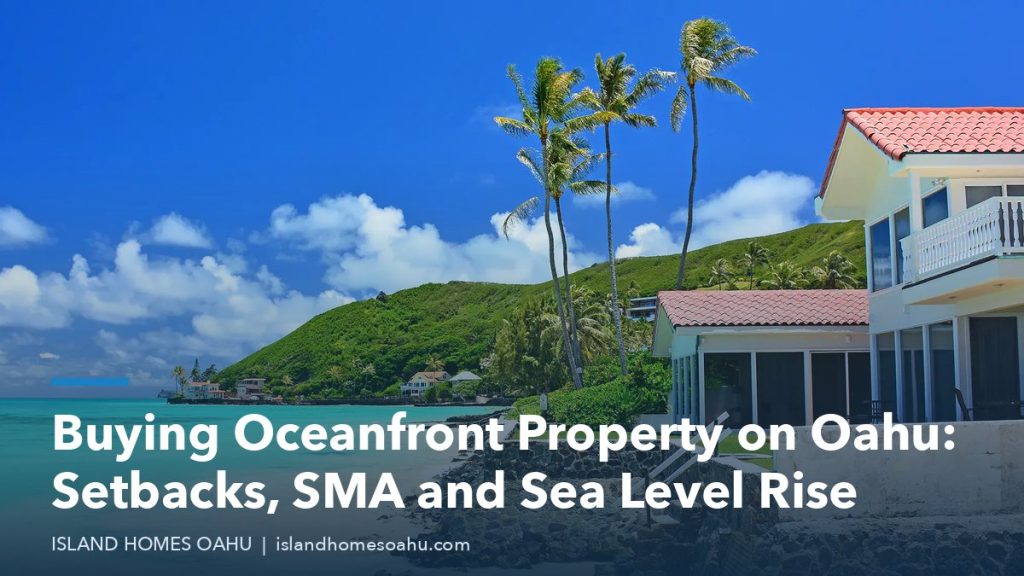
Buying oceanfront property on Oahu means buying a set of rules along with the view: where the state says the shoreline is, how far back the city says you can build, whether your project needs a coastal permit, and what the sea level rise maps show for that parcel. Get those four things checked before you write an offer, not after.
I’m Devin Hammack with Island Homes Oahu. Oceanfront homes in places like Kahala, Diamond Head, Portlock and Hawaii Kai and Kailua are where buyers get surprised most. This is the checklist I use with my oceanfront buyers, with official sources listed at the end.
Quick answer
Oahu setbacks are measured from a State certified shoreline, valid up to 12 months. Since July 1, 2024, the setback is 60 feet in urban Honolulu and 60 feet plus 70 times the annual erosion rate (up to 130 feet) in other areas with erosion data. Building in the setback needs a variance, and seawalls on sandy beaches are generally not allowed. Most coastal work also needs an SMA permit. Sellers must disclose sea level rise exposure and, on the shoreline, any erosion control structures and violations.
In this guide:
- What “oceanfront” means under the rules
- The certified shoreline
- Shoreline setbacks on Oahu
- Buying an existing oceanfront home
- Seawall rules
- SMA permits
- Sea level rise and disclosures
- Due diligence checklist
- FAQ
- Bottom line
What “Oceanfront” Means When You Are Buying Oceanfront Property on Oahu
In a listing, oceanfront is a marketing word. Under the city’s shoreline rules, the word that matters is shoreline lot. Honolulu’s ordinance defines a shoreline lot as a zoning lot with any part inside the shoreline setback area, or, when no certified shoreline survey exists, any part within 130 feet of the natural vegetation line or debris line. A lot can count as a shoreline lot even when another lot sits between it and the water.
That is why I treat “oceanfront” and “ocean view” as two different purchases. A view home up the hill may never touch these rules; a home on the sand or a seawall almost always will. My guide to Kahala vs Diamond Head vs Portlock shows how the setback rules differ by neighborhood.
What Is a Certified Shoreline in Hawaii?
The shoreline is the upper reach of the wash of the waves at high tide in the season of highest wash, usually shown by the vegetation line or debris line. Storm and seismic waves do not count.
A licensed land surveyor maps that line, but the survey only becomes a certified shoreline when the State decides where the regulatory shoreline is. Applications run through the State Land Surveyor at the Land Survey Division, with public notice, a site inspection and an appeal process. Here is what buyers need to know:
- It expires. Under HRS 205A-42 and HAR 13-222-11, a shoreline determination is valid for no more than 12 months. The exception is a shoreline fixed by an approved artificial structure with engineering drawings.
- An old survey in the seller’s file is not a current certification. If you plan to build, you will likely need a new one, and that takes time.
- It can only help so much. Once a shoreline is certified and a setback line is set, Honolulu’s ordinance says a later survey cannot move the setback line farther seaward.
- Sometimes you do not need one. The Honolulu DPP coastal permits page says a certified shoreline survey is not required if the work is mauka of a “waiver line” 15 feet inland of the setback line. A surveyor, architect or engineer still has to show the shoreline on the drawings.
Shoreline Setbacks on Oahu: The Rules Since July 2024
State law, HRS 205A-43, sets a floor of at least 40 feet inland from the shoreline. Honolulu went further. Ordinance 23-3, which amended the city’s shoreline setback chapter (Chapter 26 of the Revised Ordinances of Honolulu), kept the 40 foot line until July 1, 2024, and then switched to these distances measured mauka from the certified shoreline:
| Where the lot is | Setback from the certified shoreline |
|---|---|
| Primary Urban Center plan area (urban Honolulu) | 60 feet |
| Other plan areas with measured erosion | 60 feet + (70 x annual erosion rate), up to 130 feet |
| No erosion data, accretion, or a zero erosion rate | 60 feet |
Example: a lot eroding half a foot per year gets 60 + (70 x 0.5) = 95 feet. Rates come from the Hawaii Shoreline Study data, and an owner can apply for an alternative rate if the mapped one does not fit. The city also issues a setback line determination on request, one of the first things I suggest for a buyer planning to build.
Shallow lots
If the setback shrinks a lot’s buildable area below 1,500 square feet, the director can adjust the line to allow 1,500 square feet, but never closer than 40 feet to the certified shoreline, with no new shoreline hardening, the home placed as far mauka as possible and the lowest floor raised (3 feet above base flood elevation in a FEMA flood zone, or 3 feet above the highest adjacent grade in the 3.2 foot sea level rise exposure area).
Splitting an oceanfront lot
After July 1, 2024, each newly created shoreline lot must fit a 130 foot setback, with narrow exceptions for easements and lot line adjustments. Rules and erosion data can change, so check the current rules on the DPP coastal permits page before you rely on a plan.
Buying an Existing Oceanfront Home: Nonconforming Structures
Many oceanfront homes predate today’s setbacks, so part of the house may sit inside the setback. These “nonconforming” homes are legal, but limited. Under the ordinance:
- You can repair or alter a nonconforming structure as long as you do not increase or intensify the nonconformity.
- Over any 10 year period, repairs to the nonconforming part are capped at 50 percent of its replacement cost if it sits 40 feet or less from the certified shoreline, and 75 percent if it sits more than 40 feet away but still inside the setback.
- If the structure is destroyed by more than 50 percent of its replacement cost, it has to be rebuilt to current rules, and rebuilding inside the setback needs a variance.
This is the part buyers miss: the remodel you are counting on may not be allowed closest to the water. The city confirms nonconforming status per tax map key, and I want that answer and the permit history before inspections end. My leasehold vs fee simple guide covers the other title question I check on older coastal homes.
Thinking about an oceanfront home? Request a private consultation, or call or text me at (808) 459-6450.
Seawall Rules on Oahu: Can You Build or Keep One?
Under HRS 205A-44, structures are prohibited in the shoreline setback area without a variance, and existing permitted structures can be repaired but not enlarged or replaced there without one. Honolulu’s ordinance makes it city policy to prohibit shoreline hardening (seawalls, revetments, loose boulders and some landscaping) unless needed for coastal restoration or a clear public benefit.
- Sandy beaches: both HRS 205A-46 and the city ordinance say a variance to artificially fix the shoreline will not be granted where there is a sand beach or where it could interfere with recreation or natural sand supply, unless it is clearly in the public interest.
- Strings attached: the city can approve a setback variance on the condition that the property can never get a later variance for shoreline hardening.
So when a listing has a seawall, I ask: was it permitted, and is the permit current? The seller now has to answer that in writing, covered below.
SMA Permits on Oahu: When You Need One
The Special Management Area is a coastal zone mapped inland from the shoreline. Most “development” inside it, including construction, grading or a change in how intensely the land is used, needs an SMA permit under Chapter 25 of the Revised Ordinances of Honolulu. According to the DPP Minor SMA Permit page:
- A Minor SMA permit covers projects valued up to $500,000 on a shoreline lot, or up to $750,000 on a lot that is not a shoreline lot. Larger projects, or ones with substantial adverse effects, go through the Major SMA process. State law adjusts those valuations for inflation every five years.
- Up to two homes under 7,500 square feet of floor area can be exempt, but only if the lot is not a shoreline lot, is not in flood zone V or VE, and is not susceptible to 0.5 feet of sea level rise on the state viewer. On a true oceanfront lot, that exemption usually falls away.
- The DPP decides a Minor SMA permit within 45 days of a complete application, and the site plan for a shoreline lot must show the certified shoreline, setback line and the sea level rise and erosion lines.
Unsure? The city takes SMA determination requests through its HNL Build portal. The practical takeaway is time: a certified shoreline, a setback determination and an SMA permit can all come before a building permit, so budget months, not weeks, for a rebuild.
Sea Level Rise and Disclosure on Oahu
The Hawaii Sea Level Rise Viewer, built by PacIOOS for the state, maps a Sea Level Rise Exposure Area (SLR-XA). It combines three hazards: passive flooding at high tide, annual high wave flooding and coastal erosion, modeled at 0.5, 1.1, 2.0 and 3.2 feet of sea level rise. The state’s 2022 report recommends planning for at least 4 feet, using the 3.2 foot exposure area until updated maps exist.
Under HRS 508D-15, a seller must disclose if the home is in the state’s sea level rise exposure area (Act 179 of 2021, effective May 1, 2022). Since 2023, a seller of a home adjacent to the shoreline must also disclose:
- All permitted and unpermitted erosion control structures on the parcel
- Expiration dates of any permitted structures
- Any notices of alleged violation tied to the parcel
- Any fines for expired permits or unpermitted structures
One catch: if a map boundary is unclear, the law resolves it in the seller’s favor when they made a good faith effort, so I look up the parcel myself. For FEMA zones and flood insurance, see my guide to flood zones on Oahu.
Due Diligence Checklist for Buying Oceanfront Property on Oahu
- Ask for any shoreline surveys, certified shoreline maps and setback determinations the seller has, and note the certification dates.
- Pull the permit history for the home and any seawall or revetment, and compare it to the seller’s erosion control disclosure.
- Check the parcel on the Hawaii Sea Level Rise Viewer at 0.5 and 3.2 feet, and check the FEMA flood zone.
- If you plan to remodel or rebuild, request a setback line determination and confirmation of nonconforming status early.
- Confirm whether the work needs an SMA permit or qualifies for an exemption.
- Get insurance quotes during your inspection period and talk to your lender about how the property affects your loan.
- Have a real estate attorney review encroachments, old shoreline structures or violations.
If you are buying from the mainland or overseas, my guide on how to buy a home on Oahu from the mainland covers how to run these checks remotely. For the broader high end market, start with luxury homes on Oahu.
Buying Oceanfront Property on Oahu: FAQ
How far back from the ocean can you build on Oahu?
Since July 1, 2024: 60 feet from the certified shoreline in urban Honolulu, and 60 feet plus 70 times the annual erosion rate, up to 130 feet, elsewhere with erosion data. Lots with no erosion data get 60 feet.
How long is a certified shoreline good for in Hawaii?
Up to 12 months, under HRS 205A-42 and HAR 13-222-11, unless the shoreline is fixed by an approved artificial structure with engineering drawings.
Can I build a seawall on my Oahu oceanfront property?
Rarely. It needs a variance, and one to fix the shoreline is not granted on a sand beach unless clearly in the public interest.
Do I need an SMA permit to build a house on the beach?
Usually. The home exemption does not apply to shoreline lots, flood zones V or VE, or lots susceptible to 0.5 feet of sea level rise.
Does a seller have to disclose sea level rise in Hawaii?
Yes. HRS 508D-15 requires disclosure of the sea level rise exposure area, and shoreline sellers must also disclose erosion control structures, violations and fines.
Bottom Line
Buying oceanfront property on Oahu is less about the house and more about the line in front of it. Know the certified shoreline, the setback, whether the home is nonconforming, the seawall paperwork and the sea level rise maps, and you can price the home with clear eyes. This is general information, not legal advice, so have an attorney, surveyor or architect confirm the rules for your parcel.
Sources
- City and County of Honolulu Ordinance 23-3 (Bill 41, 2022), Shoreline Setbacks
- Honolulu DPP: Coastal Area Permits
- Honolulu DPP: Special Management Area Minor Permit
- Hawaii Revised Statutes 205A-22, Definitions (SMA)
- Hawaii Revised Statutes 205A-42, Determination of the Shoreline
- Hawaii Revised Statutes 205A-43, Shoreline Setbacks
- Hawaii Revised Statutes 205A-44, Prohibitions
- Hawaii Revised Statutes 205A-46, Variances
- Hawaii Administrative Rules 13-222-11, Validity of Certified Shoreline
- Hawaii DAGS Land Survey Division: Shoreline Certification
- Hawaii Revised Statutes 508D-15, Mandatory Seller Disclosures
- Session Laws of Hawaii 2021, Act 179
- PacIOOS: Hawaii Sea Level Rise Viewer
- DLNR OCCL: Hawaii Sea Level Rise Vulnerability and Adaptation Report, 2022 Update
Looking at oceanfront homes on Oahu? Request a private consultation, or call or text me at (808) 459-6450. I am Devin Hammack with Team Taparra at eXp Realty.
Get the free 11 step first time buyer plan by email: what you can really afford, condo vs house, and help with closing costs.
Send Me the Planor call or text (808) 459-6450