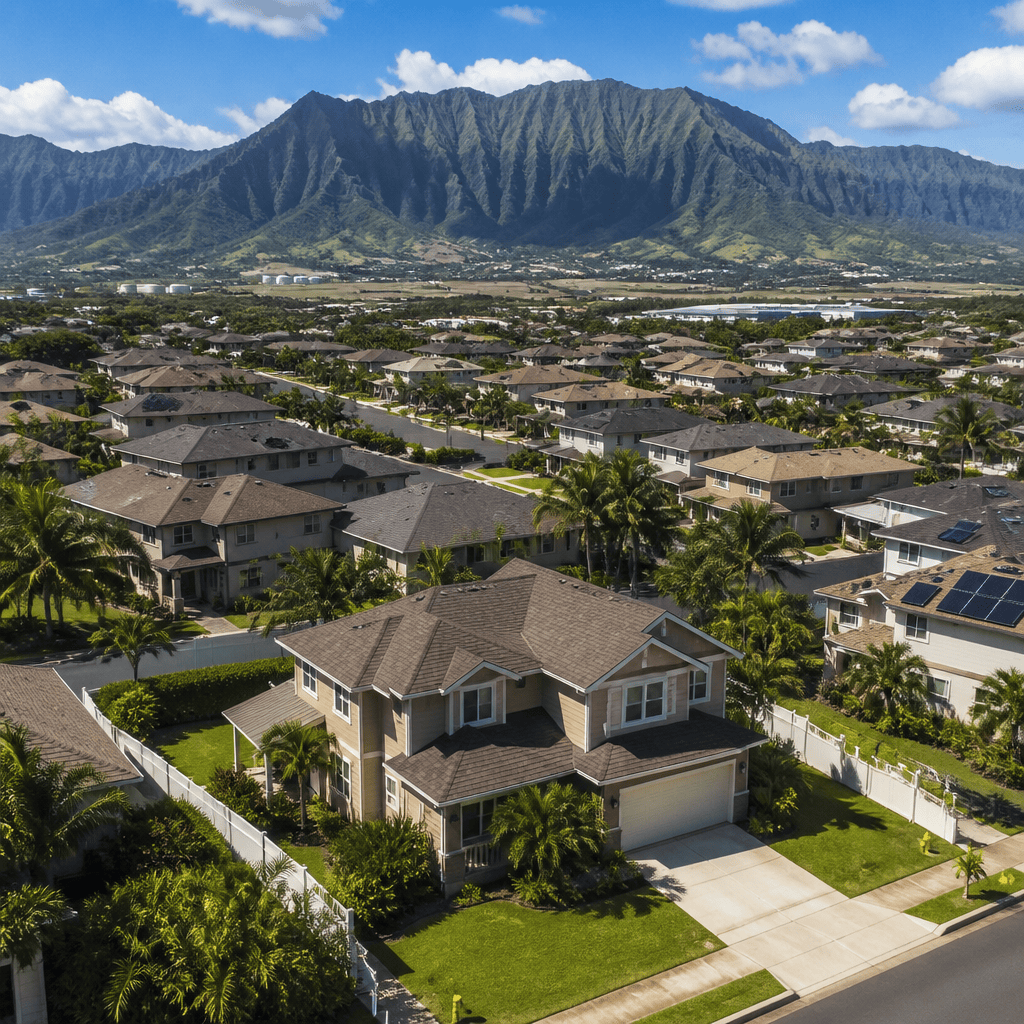
A PCS to Hawaii is exciting. It might also be a little overwhelming when you realize just how different the housing market is compared to where you’ve been stationed before. Oahu’s real estate market moves fast, inventory is tight, and the cost of living is higher than almost anywhere else in the country. But with the right preparation and a plan in place, buying a home during your PCS can be one of the smartest financial decisions of your military career.
I’m a Navy veteran. I got my own orders to Hawaii once, felt exactly what you’re feeling, and stayed. Now I help military families do the same thing every month.
This guide covers everything from the moment you get your orders to the day you pick up your keys, including temporary housing, remote house hunting, neighborhoods near every major base, school districts, and all the logistics that make a Hawaii PCS unique.
Your PCS to Hawaii Timeline: Start the Moment You Get Orders
Most service members get their PCS orders 4 to 6 months before their report date. That window is your biggest advantage. Use it.
Month 1 to 2: Get your finances ready. Pull your credit reports, pay down any revolving debt, and avoid opening new lines of credit. If you’re using a VA loan (and you should seriously consider it), get pre-approved with a lender who specializes in VA loans in Hawaii.
Month 2 to 3: Connect with a local agent and start your search remotely. You don’t need to be on island to start looking at homes. A good buyer’s agent will set you up with a custom MLS search, send you listings that match your criteria, and do video walkthroughs of properties you’re interested in. I use FaceTime and Zoom to walk buyers through homes in real time, pointing out things photos don’t show (noise levels, street traffic, the view from the lanai, the condition of common areas in condo buildings).
Month 3 to 5: Narrow your search and make offers. If you’ve been working with your agent remotely, by the time you land on island, you should already have a short list or even be under contract. Some of my military buyers have closed on their home before they ever set foot on Oahu.
Month 5 to 6: Close and move in. Ideally, your closing is timed so you can move directly into your new home when you arrive, or shortly after.
Just got orders? Send me your report date and your base. I’ll send back a realistic price range for what you can buy near that installation, no obligation. Text or call (808) 459-6450.
What Your BAH Will Actually Cover on Oahu
Let me give you the straight version, because most PCS guides won’t.
Oahu BAH with dependents runs from roughly $3,663 for an E-5 to $4,428 for an O-3. Median single family prices near the bases currently run well above what those numbers support. A $900,000 home with a VA loan at current rates, plus taxes, insurance, and HOA, lands meaningfully above E-5 and E-6 BAH. If you’ve been told your BAH will simply cover a house here, that’s outdated advice.
What that means for you:
Townhomes and condos are the realistic entry point for most junior and mid-grade enlisted. Salt Lake, Waipahu, and Kapolei have attached housing where BAH does most or all of the work.
Single family usually requires contributing above BAH. That’s not automatically a bad call. Covering a few hundred a month to build equity instead of handing it to a landlord can be money well spent. But plan for it rather than be surprised by it.
Dual military changes the math significantly. Two entitlements open up single family inventory that’s out of reach on one.
Your other debts matter more here than at your last duty station. At these price points, a car payment can move your approval by six figures. This is the single biggest reason to talk to a lender six months out instead of two.
I’d rather tell you this now than have you discover it during house hunting leave.
Temporary Housing While You House Hunt
If your timing doesn’t line up perfectly (and it often doesn’t), you’ll need temporary housing. Here are your options:
TLA (Temporary Lodging Allowance). Active duty service members arriving in Hawaii are typically authorized TLA for up to 60 days. TLA covers the cost of temporary lodging while you search for permanent housing. The daily rate varies based on your rank and dependents, but it generally covers most or all of the cost of on-base lodging and a good portion of off-base options.
TLA is paid through your command, and you’ll need to check in with the housing office on your base to get it started. Keep all receipts and documentation.
On-base lodging. Navy Lodge, TLF (Temporary Lodging Facility), and other on-base accommodations are your most affordable option. They book up fast, especially during PCS season (summer), so reserve as early as possible. Joint Base Pearl Harbor-Hickam, Schofield Barracks, and Marine Corps Base Hawaii (Kaneohe Bay) all have temporary lodging facilities.
Off-base hotels and vacation rentals. If on-base lodging is full, you can stay at off-base hotels and apply your TLA toward the cost. Extended stay hotels near the bases (there are several along Nimitz Highway and near the Aiea/Pearl City area) tend to be the most practical option. Keep in mind that Waikiki hotels are expensive and far from most bases, so look for options closer to your duty station.
Dual Military Couples: Extra Considerations
If both spouses are active duty, a PCS to Hawaii adds a layer of complexity. Here’s what to keep in mind:
Different report dates. If you and your spouse receive orders at different times, one of you may need to secure housing alone while the other remains at the prior duty station. Having a local agent who can handle remote coordination is essential.
Separate BAH entitlements. Both service members receive BAH, which meaningfully increases your buying power and opens up single family inventory that’s hard to reach on one allowance. How your combined rates are calculated depends on dependent status and who claims them, so confirm exact figures with your finance office rather than assuming you’ll double the with-dependents rate.
Child care logistics. If you have children, securing childcare or school enrollment before you arrive should be a priority. Waitlists for on-base CDC (Child Development Center) spots can be months long. Register as soon as you have orders.
Pet Quarantine and Your Move Timeline
Hawaii is a rabies-free state, and the quarantine requirements for pets are strict. If you don’t prepare properly, your pet could be held in quarantine at the Animal Quarantine Station in Halawa for up to 120 days.
To qualify for the 5-day-or-less direct release program (which most military families use), you’ll need:
- Two rabies vaccinations, with the most recent given at least 90 days before arrival
- A blood titer test (FAVN test) processed by an approved lab, submitted at least 120 days before arrival
- A health certificate from your vet issued within 14 days of travel
- All paperwork submitted to the Hawaii Department of Agriculture at least 10 days before arrival
Start this process the moment you get orders. The 120 day requirement for the blood test is the biggest bottleneck. If you miss it, your pet goes into extended quarantine, and the cost comes out of your pocket.
For your housing search, this matters because you’ll want to make sure whatever home you buy allows pets. Condo buildings in particular have varying pet policies, including weight limits, breed restrictions, and limits on the number of animals. I check this before we write an offer.
Storage During Your Transition
Your household goods shipment from the mainland can take 4 to 8 weeks to arrive in Hawaii, sometimes longer during peak PCS season. Plan for a gap between your arrival and when your furniture shows up.
The military will store your belongings at origin or destination (SIT, Storage in Transit) for up to 90 days. If you need additional storage, there are several options on Oahu:
- Public Storage and Extra Space Storage have locations in Aiea, Pearl City, Waipahu, and Honolulu
- On-base storage is available at some installations but fills up quickly
- Expect to pay roughly $340 to $400 per month for a climate controlled 10×10 unit, depending on location
Neighborhoods by Base
Choosing the right neighborhood is one of the most important decisions you’ll make. Commute times on Oahu can be brutal. The H-1 freeway is among the most congested highways in the country per capita, and a home that’s only 15 miles from your base might be a 60 minute commute during rush hour.
Prices below are approximate and move with the market. If you want current numbers for a specific street or complex, message me and I’ll pull them.
Joint Base Pearl Harbor-Hickam (JBPHH)
- Ewa Beach (10 to 15 minutes): Newer construction, popular with military families. Single family homes $900K to $1M, condos and townhomes around $590K.
- Kapolei (15 to 20 minutes): The “second city” of Oahu with growing retail and dining options. Single family homes around $925K, condos and townhomes $400K to $600K.
- Aiea / Pearl City (10 to 15 minutes): Centrally located with easy access to JBPHH and Schofield. Single family homes around $1.15M, condos and townhomes around $420K.
- Salt Lake (5 to 10 minutes): One of the closest neighborhoods to JBPHH. Mostly condos and townhomes around $405K. Often the most workable option for BAH-only budgets.
- Waipahu (10 to 15 minutes): Among the more affordable options on Oahu. Single family homes around $965K, condos and townhomes around $477K.
Schofield Barracks / Wheeler Army Airfield
- Mililani (5 to 10 minutes): Consistently well-reviewed schools, parks, pools, and an established community. Single family homes $1.05M to $1.15M, townhomes $425K to $610K.
- Wahiawa (5 minutes): Most affordable option near Schofield. Homes from $620K to $760K.
- Royal Kunia (10 minutes): Newer construction with a suburban layout, minutes from Schofield’s back gate.
Marine Corps Base Hawaii (MCBH Kaneohe Bay)
- Kailua (10 minutes): Upscale beach town. Single family homes $1.55M to $1.74M, condos $400K to $810K.
- Kaneohe (5 to 15 minutes): More affordable than Kailua, with single family homes around $1.27M. Windward side, so expect more rain and greener surroundings.
- Kahaluu / Ahuimanu (10 minutes): Quiet residential pockets tucked into the valley, close to base.
One Oahu-specific thing worth knowing before you shop: some properties here are leasehold rather than fee simple, meaning you own the building but lease the land. VA financing has specific requirements around lease terms, and the discount you see on those listings exists for a reason. I wrote a full breakdown of leasehold vs fee simple on Oahu if you run into one.
School Districts and Education
Hawaii has a single statewide school district (the Hawaii Department of Education), which is unique among U.S. states.
Frequently requested public schools on Oahu:
- Mililani High School and Mililani Middle School
- Kailua High School
- Kapolei High School
- Moanalua High School
- Roosevelt High School (Honolulu)
Private schools are popular on Oahu, with Punahou, Iolani, Mid-Pacific Institute, and several military affiliated schools.
DoDEA schools (Department of Defense Education Activity) are available on some installations and are tuition free for military dependents.
School boundaries and ratings change. Verify current assignment and performance data directly with the Hawaii DOE for any address you’re serious about.
Working with an Oahu Realtor Remotely During Your PCS
Video tour capability. Your agent should be willing and able to walk through homes on video calls with you, pointing out details that listing photos don’t show.
Local knowledge. An agent who lives and works on Oahu can tell you that a certain street floods during heavy rain, or that a new development is planned across the street from the listing you love.
Military experience. An agent who has worked with military buyers understands BAH, VA loan requirements, tight PCS timelines, and the urgency of your situation.
Availability across time zones. If you’re PCS’ing from the mainland or overseas, there’s a time zone gap. Your agent should be flexible with scheduling.
Financial Tips for Your Hawaii PCS
Factor in Hawaii’s cost of living. Groceries, utilities, and gas are all higher on Oahu. Electricity in particular runs well above mainland rates, which is why solar comes up in almost every conversation I have with buyers here.
COLA (Cost of Living Allowance). Active duty service members on Oahu receive COLA, which helps offset the higher cost of living. COLA is not treated the same as BAH for loan qualification purposes, so ask your lender how yours is handled.
Consider the investment angle. Many military families buy on Oahu and then keep the home as a rental when they PCS out. Oahu’s rental market is consistently strong, driven in large part by the same military rotation cycle you’re part of.
Ready to Start Your PCS to Hawaii?
If you’ve read this far, you’re already ahead of most families who arrive on island without a plan.
Here’s the next step: text or email me your report date, your base, and your rank. I’ll send back a realistic price range, two or three neighborhoods that fit, and an honest read on whether buying or renting makes more sense for your tour length. No pressure, no drip campaign.
I’ve been where you are. Let’s make this part easy.
Island Homes Oahu is not affiliated with the Department of Defense or any branch of the U.S. military. BAH rates referenced are approximate and should be verified at militarypay.defense.gov. This post is for informational purposes only and does not constitute financial, tax, or legal advice. All prices are approximate and subject to change.
Get the free 11 step first time buyer plan by email: what you can really afford, condo vs house, and help with closing costs.
Send Me the Planor call or text (808) 459-6450